Brand Management in the Age of AI
Our free white paper on AI--ready brands: How AI is transforming brand identity, content, and visibility
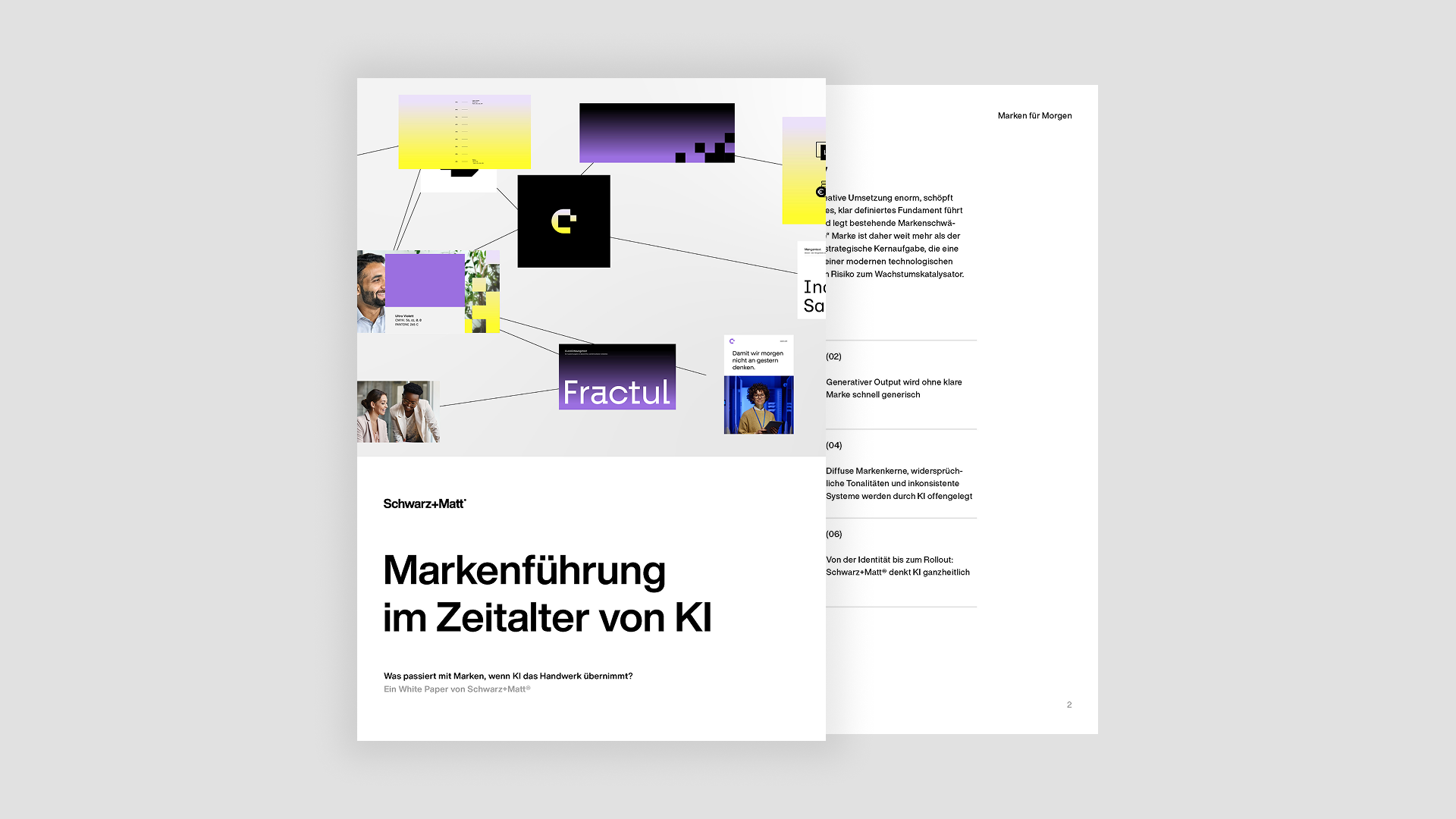
(Overview)
White Paper:
Brand Management
in the Age of AI
AI is fundamentally changing how brands are managed, produced, and communicated. The question is no longer whether you use AI, but what happens if you do so without a clear brand identity.
After all, AI merely scales what already exists; it does not create identity on its own. Those who fail to lay an AI-ready foundation for their brand risk becoming just another face in the crowd rather than standing out.
This white paper outlines what brands need today to remain distinctive in the AI era—including current studies and a brand check covering brand identity, AI readiness, risks, and impact measurement, so you can honestly assess your own status quo.
The Five Key Points of the White Paper
(01) AI Puts Pressure on Brand Identity
AI-generated content is on the rise, and with it, the pressure on everything that makes a brand unique.
(02)Without a clear brand, output becomes generic
If you use AI without a brand foundation, you’ll end up with error-free content that doesn’t sound like anyone.
(03)AI supports execution but does not replace identity
Headlines, visuals, campaigns: AI provides forms of expression. It’s up to humans to define what lies behind them.
(04)AI reveals ambiguities
Vague positioning, contradictory tones, inconsistent systems: AI reveals what was not clearly discernible before.
(05)Being AI-ready means having the right infrastructure
Machine-readable brand identity, brand intelligence, and clear guidelines: These are the building blocks that make a brand AI-ready.
Our Well-Reasoned Response to AI
This isn’t a tool recommendation, nor is it simply a checklist. Instead, it’s the strategic question that comes first: What needs to be in place for AI to benefit your brand rather than work against it? As a brand and design agency, we grapple with this question every day. This is our answer. To arrive at it, we combine the latest studies and market observations with real-world experience.
A white paper for:
You use AI and generate a lot of content, but at some point it starts to feel generic and no longer reflects your brand.
AI has made its way into your teams. But what happens to your brand when everyone uses different prompts, different tools, and produces different results?
Your customers are asking questions about AI strategies, GEO, and future-proof brand management. You want to provide well-informed answers—not superficial ones.
Download the white paper for free
FAQs on Brand Management and AI
What Does AI Mean for Brand Management?
AI makes brand communication faster, more scalable, and more versatile. At the same time, it raises the bar for brand management: The more content that is generated automatically, the more clearly positioning, tone, and design must be defined.
AI can consistently promote a brand, but only if its identity is precisely described and established as a reliable foundation. That is why AI is increasingly becoming a litmus test for how clearly a brand is actually positioned.
Why does the use of AI lead to generic content?
AI does not automatically generate arbitrary content. However, the risk increases when many companies use the same models, enter similar prompts, and fail to specify brand guidelines. In such cases, AI primarily reproduces familiar patterns: The content is accurate and efficient, but it sounds just like many other brands.
What does machine-readable brand identity mean?
A machine-readable brand identity translates positioning, values, tone, design principles, and product information into a clear, structured framework. This enables AI systems to better understand and represent a brand, and to apply it consistently across various applications.
What does GEO mean for brands?
Content for AI-based search systems such as ChatGPT, Perplexity, or Gemini. The goal is for these systems to be able to identify a brand, classify it correctly, and incorporate it into relevant responses.
What role do people play in AI-driven brand management?
AI can accelerate creative processes, develop variations, and produce initial drafts. However, strategy, approach, selection, and quality control remain human tasks. It is only through this combination that AI becomes a tool for strong brands—rather than a producer of interchangeable content.